
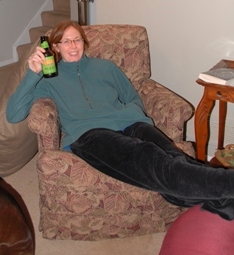
A much-deserved beer was part of my post-race recovery.
For many years, the longest run I ever trained for was a 10K. I usually ran consistently, but would really ramp up a training program about 2-3 months prior to the 10K. Inevitably after the 10K I was always likely to fall off the running bandwagon, sometimes for a week or two, sometimes for a month or more. The last several years I have participated in the local 10-miler and would train for that for months only to also take the same “break” from running as I had once the 10K was complete. Weeks or more would go by with no running at all.
These lapses from running were by no means my intentional post-race recovery plan. Perhaps it was the time of year, my busy work schedule, my lack of motivation once the run was complete, but I never had a post-race plan and so I would simply drift away from running for a bit.
Training for a marathon is slightly different than training for a 10K or 10-miler but I admit to having had the same fear that I might fall into a non-running slump post-race. This has been a strange week though because I feel like in a way I lost a little part of me. People have written about this strange feeling of loss post-marathon and I never really understood that until now. You spend months and hours of your life preparing for one moment and all of a sudden when it’s over so is everything you’d been working toward. You have achieved what it is you set out to achieve and so you are essentially right back where you started. Clean slate. This is an opportunity that you have to be willing to run with again.
Develop a Mental and Physical Plan
Post-race recovery for me is much more mental than it is physical, though the physical is absolutely critical to long-term success. For three days I have felt antsy, guilty for not running, off-kilter without running as part of my morning routines, and yet slightly relieved that I have been letting my body relax, be still, and repair. My past behaviors make me fear a little bit that I will stall running, but I am grateful for knowing how much I have come to love this sport and my eagerness to be running and training again will no doubt overpower my fears. The fact that I continue to be consumed with thoughts and plans for “the next one” are also encouraging.
So what is my plan? This first week has included very simple stretching, icing, foam roller massaging, yoga, and easy activity. While I understand that my muscles, and my IT band in particular, need time to repair I am ready to get back into cardio work that will boost my heart rate. I’m grateful that I learned to love the bike recently and will likely use the next week to log time on the stationary bike at least 4 days with some strength training and Pilates mixed in. That gives me three weeks to build back up my running and hopefully increase my pace to 8-minute miles for my 10K race April 4th. A bit ambitious? Maybe. Worth trying? Definitely.
My post-race recovery plan is entirely based on feeling good, remaining focused, and building back up at a level that is comfortable for me. I could not run the marathon alone and I cannot recover alone. I have learned from others about what worked for them and have customized a stretching, cardio, and new training plan that works best for me and my goals. I plan to focus on the muscles that felt weakest during my last run (lower back, glutes, ankles) and will be including more dynamic stretching to the beginning of each work-out as well as proper cool-downs after.
Post-race recovery for me will be a very new beginning and I look forward to starting fresh.
 One of the things I have enjoyed most about having run a marathon is how much I learned along the way. I am very aware that I have barely scratched the surface of most topics related to running and training and I find it encouraging that there is always something new to learn about the sport. Part of running is science and understanding how the body works and how all the muscles work together, and part of running simply personal and figuring out what works best for you.
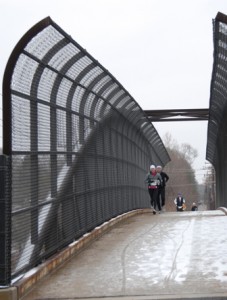 When I decided I wanted to run a marathon it was last October and I was only slightly enamored with the idea. Knowing that I might get serious about it, I continued to run through November and December but only put in 9-12 miles a week, maybe a little more on warmer days. By the end of December I had committed myself to the March 1st marathon and my running friend and I decided we would officialy start training January 3rd.
 This morning as I was walking down the stairs sideways, slowly, holding on to the railing, and feeling each step in my knees and ankles I smiled knowing that for all this pain I would not change having just run my first marathon less than 24 hours ago.
 I believe it is not just coincidence that I have made it through this entire 2009 winter without a cold. I don’t typically get sick to begin with (knocking on wood now) and the last time I had a sore throat and stuffed up noise was just after the Christmas holidays. My big goal for this past winter was to run through it, and November and December were months I used to get used to running in the cold. I was outside for 3-4 mile runs three times a week. I had been mentally preparing to start true marathon training after New Years and so my first few runs of 2009 were indeed with a runny nose, but it didn’t last long. I have been sniffle-free this winter while everyone around me has had the flu, the common cold, aches and pains, and I believe I have running to thank for keeping my immune system strong.
  There is no question that individual runners and athletes will find the diet, routine, and training that works best for their own goals, pace, and body type. An interesting debate on
  There is officially one week until my first marathon. Last week had a bit of a monkey wrench tossed in because of pain I started to experience in my
  At the end of a long run, the legs are inevitably tired which is to be expected. I understand the important role that the knees play in running and that they certainly carry a lot of the body’s weight and movement. Doing core exercises and strengthening and stretching the pelvis, hips, and legs will help the knees and legs remain strong during a run. Without a strong core to keep the body in a nice straight line while running, your knees will bear the brunt of any sideways movement of the body and you’ll feel the pain later.
 I have been a long-time subscriber to SELF Magazine and kept back issues for more years than I would like to admit. I’ve seen the magazine change and evolve and always found something in its pages that interested me throughout my teenage years where I just wanted to be inspired to my college dieting years to my adult years of focusing on healthy fitness. To no fault of SELF (sorry SELF), I have been letting my subscription run out in favor of reading Runner’s World, running websites, and blogs which appeal directly to my current goals.
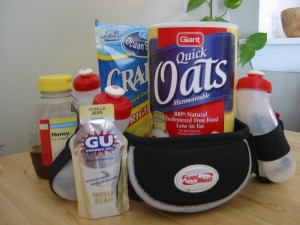 For the last few weeks I have been dabbling lightly with the best pre-run routine for long Sunday runs. I’m acutely aware of the need to fuel up before heading out but I’ve also become more in tune with the amount of time it takes for my body to wake up and go through its own routines.